- The rule. A blend declares its total and lists its contents heaviest first.
- The order. Magnesium glycinate is the largest item; CoQ10 the smallest.
- The ceilings. The item in place n weighs no more than 575 divided by n.
- The carrier. The glycinate that carries 80 mg of magnesium takes up much of the 575 mg.
What the labelling rule requires
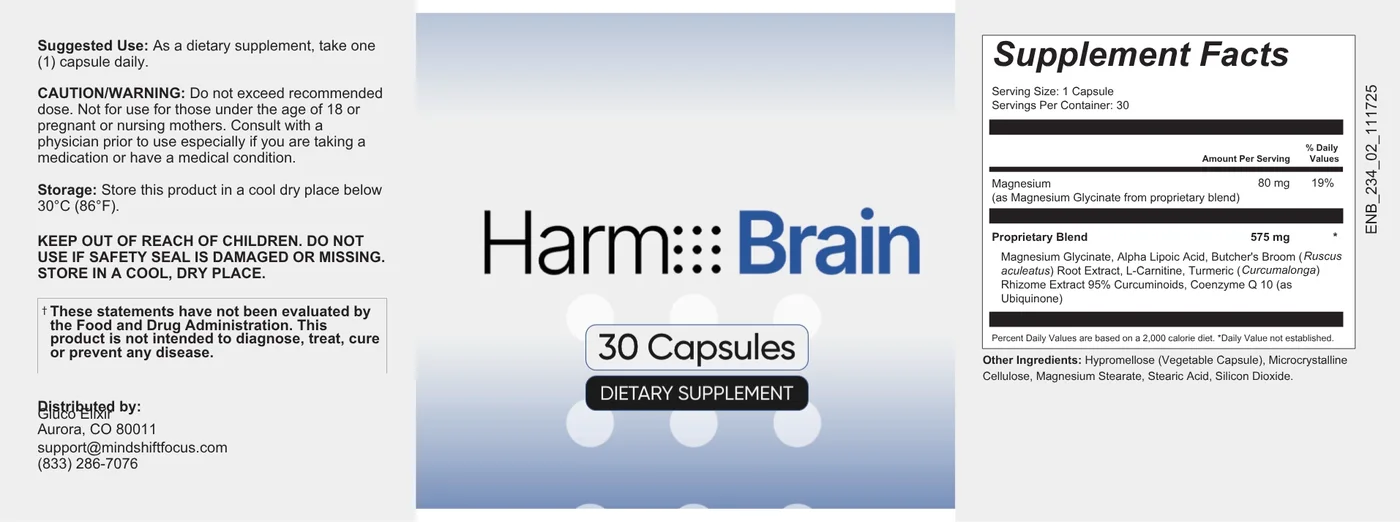
Under the federal rule for Supplement Facts panels, a proprietary blend must declare its total weight and list its ingredients by weight, heaviest first. It does not have to give the individual amounts, and on most brain supplement labels it does not.
That can look like a wall. It is closer to a window with frosted glass: you cannot read each figure, but the order and the total are fixed by law, and they support more reasoning than most buyers expect.
The six names, in order
- Magnesium glycinate. Magnesium bound to glycine; the carrier of the printed 80 mg.
- Alpha lipoic acid. A sulphur-containing compound the body makes and uses inside mitochondrial enzymes.
- Butcher’s broom (Ruscus aculeatus) root extract. A Mediterranean shrub studied for vein tone in the legs.
- L-carnitine. The shuttle that carries fatty acids into mitochondria.
- Turmeric (Curcuma longa) rhizome extract, 95% curcuminoids. Turmeric root standardised to its yellow pigments.
- Coenzyme Q10, as ubiquinone. A link in the mitochondrial electron transport chain, in its oxidised form.
Four of the six are energy chemistry and one is a circulation botanical, which is the grouping behind the seller’s own description of a mitochondrial and circulatory formula. Turmeric, fifth, fits neither word: it is a standardised botanical extract with research of its own, on memory and on absorption.
What the order proves
Descending order has a simple consequence. If six items add up to 575 mg and each weighs no more than the one before it, the second item can be at most half the total, the third at most a third, and so on down the list. The first item has to weigh at least a sixth of the total, or the list could not add up.
| Place | Material | Most it can weigh, by order alone |
|---|---|---|
| 1 | Magnesium Glycinate | Up to the whole 575 mg, and at least a sixth of it |
| 2 | Alpha Lipoic Acid | About 288 mg (575 ÷ 2) |
| 3 | Butcher’s Broom (Ruscus aculeatus) Root Extract | About 192 mg (575 ÷ 3) |
| 4 | L-Carnitine | About 144 mg (575 ÷ 4) |
| 5 | Turmeric (Curcuma longa) Rhizome Extract 95% Curcuminoids | About 115 mg (575 ÷ 5) |
| 6 | Coenzyme Q10 (as Ubiquinone) | About 96 mg (575 ÷ 6) |
In a list of six that runs heaviest first and adds up to 575 mg, the item in place n can weigh no more than 575 ÷ n, and the first must weigh at least a sixth of the total.
These are ceilings, not estimates. Real amounts sit at or below them, usually well below, because the ceilings assume every later item is as heavy as it is allowed to be. They are still useful: CoQ10, last on the list, cannot weigh more than about 96 mg in a capsule, and alpha lipoic acid, second, cannot weigh more than about 288 mg.
The magnesium figure changes the picture
The ceilings use the order alone. The panel gives one more fact: the glycinate at the top of the blend carries 80 mg of magnesium. Magnesium is only part of the weight of magnesium glycinate, so the carrier weighs a good deal more than 80 mg.
The 80 mg of magnesium comes from magnesium glycinate inside the 575 mg blend. If that is fully reacted magnesium bisglycinate, which is about 14% magnesium by weight, 80 mg of magnesium takes roughly 567 mg of it, leaving about 8 mg for the other five blend materials together. A buffered glycinate carries more magnesium per milligram and would leave more room. The label does not say which form is used, and it does not print the five amounts.
Either way the direction is the same. The first item takes up much of the blend, and the five below it share what is left. That is a fact about how the label is built, and it is the reason every research amount on this website sits in a column of its own.
Six materials, one capsule a day
A 575 mg blend listed heaviest first, with 80 mg of magnesium printed. Order Harmo Brain through the official checkout.
Price at checkout · 60 days from purchase
Setting the order beside the research
Three of the six materials have research amounts that make the point plainly. Oral alpha lipoic acid trials used 600 to 1,800 mg a day; an L-carnitine trial used 1.5 g a day; a CoQ10 trial used 400 mg a day. Each of those is more than the ceiling the order sets for that material, and in two cases more than the whole blend.
| Ingredient | What studies used | What the label prints | Source |
|---|---|---|---|
| Alpha lipoic acid | 600, 1,200 and 1,800 mg a day in diabetic nerve trials. No dementia trial met Cochrane’s criteria. | Second in the 575 mg blend | Hsieh RY, Sauer J |
| L-carnitine | 1.5 g a day for 10 weeks in prefrail older adults; oral doses of 1 to 6 g are 5 to 18% absorbed. | Fourth in the 575 mg blend | Badrasawi M, Evans AM |
| Coenzyme Q10 (ubiquinone) | 400 mg a day for 12 weeks in adults averaging 74; blood levels rose, muscle mitochondria did not change. | Last in the 575 mg blend | Schmücker M |
Every research amount on this page is the amount a published study gave. Harmo Brain prints one amount, 80 mg of magnesium; the other five materials share a 575 mg blend, so none of these trial figures describes the capsule.
None of the trials tested this capsule, and several ran in people with a diagnosis. The table is there to keep the two kinds of number apart, which is the whole discipline of reading a blend.
Why labels use blends at all
Sellers give two reasons for proprietary blends. One is protecting a formula: a list of exact amounts is a recipe, and a blend keeps it from being copied line for line. The other is practical: a blend declared by its total can be adjusted between batches within the same order without reprinting every figure.
Both reasons are real, and the rule permits them. The cost falls on the buyer, who gets a total and an order instead of six numbers. The fair response is neither to assume the worst nor to assume the best, but to use what the rule guarantees, the total and the order, and to keep research amounts out of the guesswork.
- Ask the seller whether the amounts are available on request; some publish them elsewhere.
- Check whether any printed figure, like the 80 mg here, belongs to an item inside the blend.
- Treat any page that quotes a trial dose as the capsule’s content as a red flag.
What the order cannot tell you
The order tells you
- Which material is the heaviest and which the lightest.
- A ceiling for each material, from the total and its place.
- Enough names for a full interaction check.
The order cannot tell you
- Any individual amount below the magnesium figure.
- Whether two neighbouring materials weigh almost the same or very differently.
- The exact form of the glycinate, which moves the arithmetic.
Two lists that count differently

The seller’s list names seven items: magnesium (80 mg declared), magnesium glycinate, alpha lipoic acid, butcher’s broom, L-carnitine, turmeric extract and CoQ10. The panel names six materials. The difference is bookkeeping: the list counts magnesium once as the printed figure and once as the glycinate that carries it.
What the panel adds is the grade of three items, which the list leaves out: butcher’s broom as a root extract, turmeric as a rhizome extract standardised to 95% curcuminoids, and CoQ10 as ubiquinone.
How to use this at the shelf
- 1
Read the total
Find the blend weight on the panel.
- 2
Count the names
Six here. The last one weighs at most a sixth of the total.
- 3
Work the ceilings
Divide the total by each item’s place in the list.
- 4
Find the carriers
Any printed amount inside the blend brings its carrier with it.
Four steps, and any blend on any shelf becomes readable. The worked example for this product is on the supplement facts page, and the six materials each have a card on the ingredients page.
A note on what this is
Harmo Brain is a dietary supplement, not a medicine. Nothing in this article describes it as a treatment for dementia, memory loss or any other condition. Memory or thinking that is changing in a way that worries you is a reason to see a clinician, not a reason to start a capsule.
