Choosing a Brain Supplement: Eight Questions, Asked of a Real Label
Choose a brain supplement by its label, not its artwork. Check which amounts are printed, how the blend is ordered, whether any ingredient meets a medicine you take, how long the research ran and whether the refund window covers a fair test. Harmo Brain is scored against all eight questions below, including where it loses marks.
Eight Questions To Ask Of Any Label
In the order they are easiest to answer from the bottle itself.
- 1
Does it print amounts?
Every printed amount is a figure you can check against the research and the upper limits.
- 2
Is the blend ordered?
A blend must list its contents heaviest first. The order is the next best thing to amounts.
- 3
Is the serving clear?
One capsule or four? Thirty servings or twenty? The calendar depends on it.
- 4
Can you run the interaction check?
Every material named, so a prescriber can match it against what you take.
- 5
Does the research fit the window?
Trials ran for weeks or months. Does the refund window leave room for a fair test?
- 6
Do the claims match the label?
Artwork words against the label’s own description. The narrower one is the one to weigh.
- 7
Is there a real refund route?
A window, a phone line, an address and a timing, all written down.
- 8
Who is selling it?
A named seller with an address, or a page with no one behind it?
Harmo Brain Against The Eight Questions
The desk’s own product, scored by the desk’s own checklist, with the incentive stated on every page.
| 1. Printed amounts | Partly. One of six materials carries an amount: magnesium, 80 mg. |
|---|---|
| 2. Blend order | Yes. 575 mg, six materials, heaviest first. |
| 3. Serving | Yes. 1 capsule, 30 servings. |
| 4. Interaction check | Yes. All six materials named, five of them with published interaction points. |
| 5. Research against the window | Partly. Trials ran 10 weeks to 18 months; the window is 60 days from purchase. |
| 6. Claims against the label | Mixed. The label says mitochondrial and circulatory formula; the artwork says more. |
| 7. Refund route | Yes. 60 days, a phone line, a returns address and stated timings. |
| 8. Seller | Yes. Harmobraine, a USA Authorized Harmo Brain Retailer, New York. |
| Overall | Five yes, two partly, one mixed: a clear label and refund route, one printed amount |
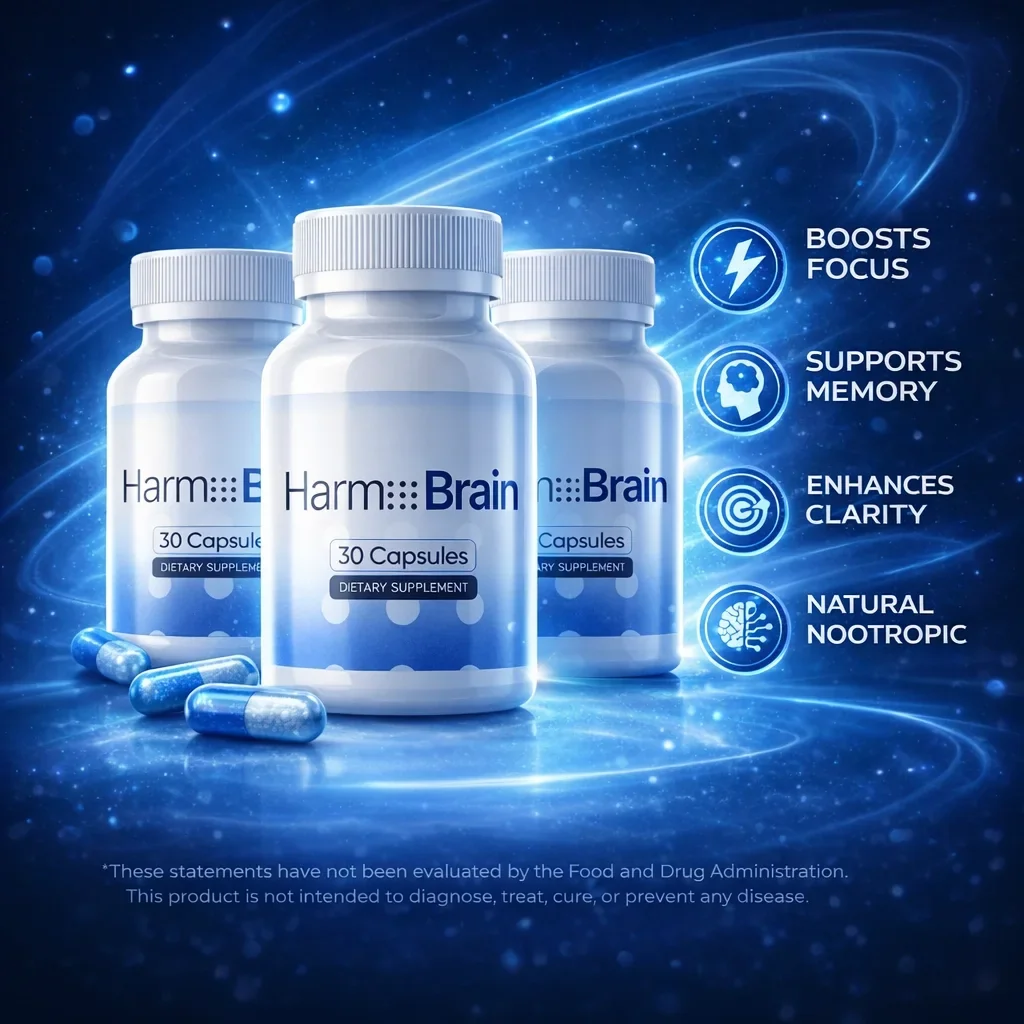
Harmo Brain does well where a label can be read: the serving, the blend order, the named materials, the refund route and the seller. It does less well on the two questions a single capsule of a blend finds hardest, printed amounts and a research base that fits a 60-day window.
The claims question is marked mixed rather than failed because the label itself is modest. The stronger words are on the seller’s artwork, and this website quotes them as artwork only.
Run the same eight questions on any other bottle you are considering. A product that scores lower on the first four has a label that tells you less; one that scores lower on the last two is harder to walk away from.
Where Harmo Brain Loses Marks
Two questions, stated once and in full.
The label prints one amount. The 80 mg of magnesium comes from magnesium glycinate inside the 575 mg blend. If that is fully reacted magnesium bisglycinate, which is about 14% magnesium by weight, 80 mg of magnesium takes roughly 567 mg of it, leaving about 8 mg for the other five blend materials together. A buffered glycinate carries more magnesium per milligram and would leave more room. The label does not say which form is used, and it does not print the five amounts.
That arithmetic is the reason question one reads “partly”. It does not make the capsule empty; it means the five other materials are present in amounts a buyer cannot read, and the research amounts on the ingredients page stay in a column of their own.
Question five reads “partly” for a related reason. The curcumin study that reported memory changes ran eighteen months, and the CoQ10 study with muscle biopsies ran twelve weeks. A 60-day window is a fair test of whether a once-daily capsule suits a routine; it is not the length of those trials.
A Fair Test, On A Calendar
The calendar the checklist’s fifth question is really about.
- Before day 0
Run the interaction check
Take the six names to your prescriber if you take any medicine.
- Day 0
Order, and note the date
The refund window counts from here.
- Weeks 1 to 2
Keep the routine, not the verdict
Same time every day. Week one is the commonest complaint in this desk’s roster.
- Weeks 4 to 8
Judge it
When most of the roster decided. Two bottles take you there.
- Before day 60
Decide
Keep going, or call with the order ID to open a refund.
Matching A Pack To The Test You Plan
The window is fixed. The pack decides how much you have used by the time it closes.
| Pack | Capsules | Supply | Left when the window closes | Suits |
|---|---|---|---|---|
| 2 Bottles | 60 | 60 days | A few, one for each day in transit | A first, fair test sized to the window |
| 3 Bottles | 90 | 90 days | About 30 capsules | A test with a month in hand afterwards |
| 6 Bottles | 180 | 180 days | About 120 capsules | A routine already decided on |
At one capsule a day. The window counts from the date of purchase and the capsules from delivery, so each figure runs a little higher by the days in transit. Prices are shown at checkout.
Signs Of A Careful Label, And Red Flags
Four of each. Most labels show a mix.
Signs of a careful label
- At least one printed amount you can check against a reference figure.
- A blend that declares its total and lists its contents heaviest first.
- A caution that names who should not take it.
- A seller with a name, an address and a refund route written down.
Red flags
- Talk of proof, with no published trial of the finished product.
- Research amounts presented as if they were the capsule’s contents.
- A claim of FDA approval on a supplement: the FDA does not approve them.
- A order on the official website, or no refund address at all.
Questions To Ask Before Buying Any Brain Supplement
Six questions that take a minute each.
- Which amounts are printed, and do any of them add to something else I take?
- What is first in the blend, and what is last?
- Is any material on the label one that meets a medicine I take? CoQ10 and warfarin is the best-known example.
- How long did the research on these materials run, and in whom?
- How long is the refund window, and does it count from purchase or delivery?
- Who do I call if the parcel is wrong, and where does a return go?
A change in memory is a reason to be assessed
A brain supplement is a dietary supplement, not a treatment for dementia or cognitive impairment. Memory or thinking that is changing in a way that worries you is a reason to see a clinician, not a reason to start a capsule.
Questions About The Checklist
Is a label with more printed amounts always better?
It tells you more, which is not the same thing. Printed amounts let you check a product against the upper limits and the research; they do not make any one material work better.
Should I choose the product with the longest refund window?
Choose one whose window fits the test you plan. A window that ends before you can judge the product leaves you deciding on week-one impressions.
Why score the product this website sells?
Because a checklist is only worth trusting if it can mark its own author down. Harmo Brain loses marks on two of the eight questions, and those two are stated in full above.
Who Wrote This Checklist
Four commitments, each one checkable in a few minutes:
- The bottle is the source. The six blend materials, the 80 mg magnesium figure, the 575 mg blend total, the capsule count, the directions and the caution block come from the printed Supplement Facts panel. Contacts, the lot reference and the guarantee terms come from this retail desk’s own records.
- Research amounts live in their own column, headed “What studies used”, beside a column that says what the label prints. No sentence here moves a number from the first into the second.
- Sources are cited against their own population. Where a trial ran in people with a diagnosis, the sentence says so, and the result is not carried across to a healthy reader.
- Corrections change the date. Write to [email protected] and the review date moves forward.
We earn when you buy. Harmobraine is the USA Authorized Harmo Brain Retailer named at the top of this page, and this website makes money on orders placed through it. That is why the three-star roster lines, the note on what a proprietary blend leaves unsaid and the interaction list are printed here as well. Order support on +1 (302) 200-3480 handles tracking, changes and refunds; orders go through the official checkout only.
Sources For This Guide
- NIH Office of Dietary Supplements. Magnesium: Fact Sheet for Health Professionals. https://ods.od.nih.gov/factsheets/Magnesium-HealthProfessional/
- Badrasawi M, Shahar S, Zahara AM, Nor Fadilah R, Singh DK. Efficacy of L-carnitine supplementation on frailty status and its biomarkers, nutritional status, and physical and cognitive function among prefrail older adults: a double-blind, randomized, placebo-controlled clinical trial. Clin Interv Aging. 2016;11:1675-1686. https://pubmed.ncbi.nlm.nih.gov/27895474/
- Small GW, Siddarth P, Li Z, Miller KJ, Ercoli L, Emerson ND, et al. Memory and Brain Amyloid and Tau Effects of a Bioavailable Form of Curcumin in Non-Demented Adults: A Double-Blind, Placebo-Controlled 18-Month Trial. Am J Geriatr Psychiatry. 2018;26(3):266-277. https://pubmed.ncbi.nlm.nih.gov/29246725/
- Schmücker M, Tranberg C, Borch J, Kaae MK, Damgaard M, Flensted-Jensen M, et al. Coenzyme Q10 supplementation raises plasma levels without improving mitochondrial function in older adults. Geroscience. 2026. doi:10.1007/s11357-025-02068-9. https://pubmed.ncbi.nlm.nih.gov/41604113/
- National Center for Complementary and Integrative Health. Coenzyme Q10. https://www.nccih.nih.gov/health/coenzyme-q10
- National Center for Complementary and Integrative Health. Using Dietary Supplements Wisely. https://www.nccih.nih.gov/health/using-dietary-supplements-wisely
- 21 CFR 101.36. Nutrition labeling of dietary supplements. Electronic Code of Federal Regulations. https://www.ecfr.gov/current/title-21/chapter-I/subchapter-B/part-101/subpart-C/section-101.36
- Federal Trade Commission. Health Products Compliance Guidance. https://www.ftc.gov/business-guidance/resources/health-products-compliance-guidance
Try Harmo Brain With A Label You Can Read
One printed amount, a 575 mg blend listed heaviest first, one capsule a day and 60 days from purchase to decide.
Packs of 2, 3 or 6 bottles · price at checkout · 60 days from purchase to ask for a refund
