- 80 mg. The one amount the panel prints, as magnesium glycinate.
- 19%. Of the 420 mg Daily Value.
- 350 mg. The adult upper limit from supplements; add every product you take.
- A median 368 mg. What pooled blood-pressure trials used, not what the capsule holds.
The one number on the panel
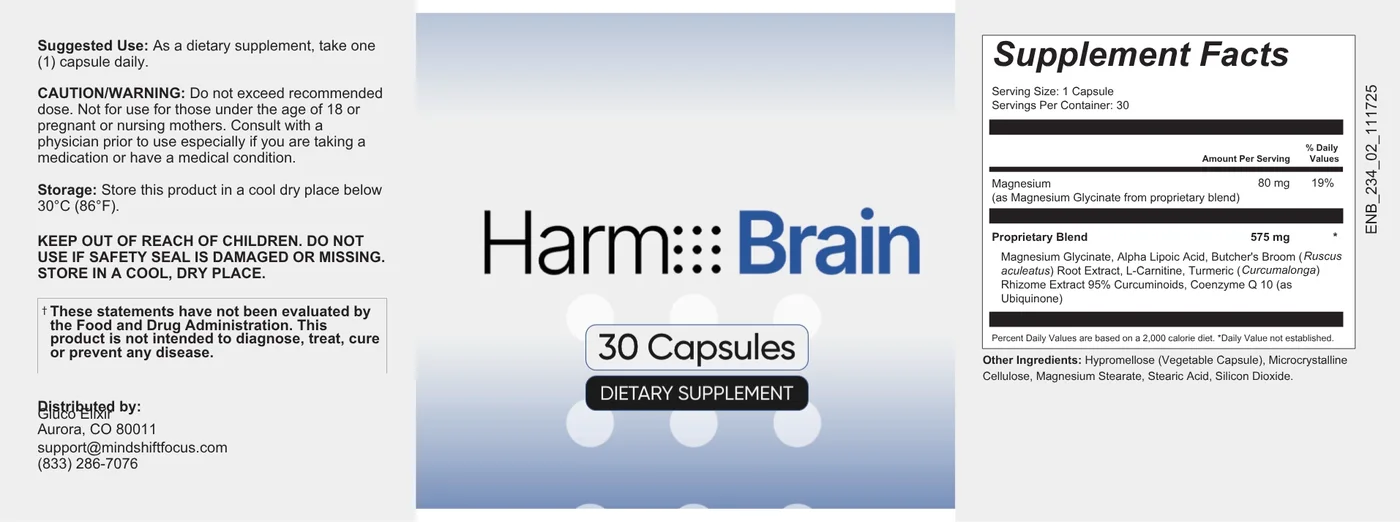
The Harmo Brain Supplement Facts panel has two rows with figures. The first reads magnesium, as magnesium glycinate from the proprietary blend, 80 mg, 19% of the Daily Value. The second is the blend itself, 575 mg, with its six materials listed heaviest first.
So 80 mg is the only amount on the label that belongs to a single nutrient, and it is the only one you can hold against a reference figure. That makes it worth understanding properly: what it is a fifth of, what it is well under, and what the research on magnesium actually used.
Nineteen percent of what
The Daily Value is the single reference amount supplement and food labels use to print a percentage. For magnesium it is 420 mg, according to the NIH Office of Dietary Supplements. Eighty divided by 420 is 0.19, which is where the 19% comes from.
The Daily Value is a labelling convention, not a personal target. It exists so that one bottle can be compared with another. A 19% figure means one capsule gives a fifth of the reference amount, and it says nothing on its own about whether you need any more magnesium than you already get.
| Figure | Amount | Where it comes from | 80 mg as a share |
|---|---|---|---|
| Harmo Brain, one capsule | 80 mg | The printed panel | The figure itself |
| Daily Value | 420 mg | The label reference amount | 19% |
| RDA, adult men | 400 to 420 mg | From food and supplements together | 19 to 20% |
| RDA, adult women | 310 to 320 mg | From food and supplements together | 25 to 26% |
| Upper limit | 350 mg a day | Supplements and medicines only | 23% |
Reference figures from the NIH Office of Dietary Supplements fact sheet on magnesium.
The RDA: what most adults need from everything
The Recommended Dietary Allowance is a different figure with a different job. It is the daily intake that meets the needs of most healthy people, and it counts food and supplements together. For adults it is 400 to 420 mg for men and 310 to 320 mg for women.
Measured against the RDA, one capsule is roughly a fifth of a man’s figure and a quarter of a woman’s. The rest comes, for most people, from food: the NIH fact sheet lists green leafy vegetables, legumes, nuts, seeds and whole grains among the richer sources.
That is the honest context for a small printed figure. Eighty milligrams is a top-up alongside a diet, not a replacement for one, and it was never presented as anything else on the label.
What magnesium does in the body
Magnesium is one of the minerals the body cannot do without. The NIH fact sheet describes it as a cofactor in more than 300 enzyme systems, including the ones that make energy: the molecule cells use as fuel, ATP, works in a complex with magnesium. It is also involved in muscle and nerve function, blood sugar control and blood pressure regulation.
That list explains why magnesium turns up in formulas sold for energy, sleep, the heart and the brain alike, and why this label groups it with the mitochondrial materials. It does not tell you that more is better. For a nutrient most people get mainly from food, the question a label can help with is whether your total is sensible, not whether a capsule changes anything.
The upper limit and your cupboard
The figure that matters most for safety is the upper limit: 350 mg a day of magnesium from supplements and medicines for adults. Food does not count towards it. The capsule’s 80 mg is 23% of that limit, which leaves a lot of room, but only if nothing else in the cupboard is using it up.
- A multivitamin or a multimineral, many of which carry magnesium.
- A separate magnesium product taken for sleep or cramp.
- Antacids and some laxatives, which can contain magnesium compounds.
- Another brain or energy supplement with magnesium in its own panel.
- 1
Line up the bottles
Everything you take in a normal week, supplements and over-the-counter medicines.
- 2
Read each panel
Find the magnesium row, if there is one, and the serving size beside it.
- 3
Add it up
The daily total, at the servings you actually take.
- 4
Compare with 350 mg
Under it, you have room. Near or over it, ask before adding anything.
It takes two minutes, it uses only numbers you can read, and it is the one magnesium question a label lets you answer completely. The NIH fact sheet notes that too much magnesium from supplements commonly shows up first as diarrhoea, nausea and stomach cramps, which is the body’s own signal that a total has crept too high.
One capsule, 80 mg, 19% DV
The one printed figure on the Harmo Brain label, well inside the upper limit. Order through the official checkout.
Price at checkout · 60 days from purchase
Why glycinate
Magnesium never arrives on its own in a capsule. It is always bound to something, and the partner decides how much of the powder is magnesium. Here the partner is glycine, the smallest amino acid, and the compound is magnesium glycinate.
On this label, the glycinate is not a separate ingredient beside the 80 mg. It is the carrier the 80 mg comes in, and it sits at the top of the blend, which by the labelling rule makes it the heaviest of the six materials.
That has a consequence for the rest of the blend, because a carrier takes up weight that the other five materials then share. The arithmetic is set out in reading a 575 mg blend, with both the fully reacted and the buffered case stated.

Magnesium on other labels
One detail trips people up when they compare bottles. A Supplement Facts panel declares the magnesium itself, sometimes called elemental magnesium, not the weight of the compound that carries it. The 80 mg here is magnesium; the glycinate it arrives in weighs considerably more.
So when you add up the cupboard, add the magnesium rows, not the compound weights. A product that lists 500 mg of a magnesium compound may deliver a fraction of that as magnesium, and its panel row is the number that counts towards the 350 mg limit.
What the magnesium research used
The largest body of magnesium trials with a clear result is on blood pressure. A meta-analysis of 34 trials in 2,028 adults found that a median of 368 mg a day for a median of three months lowered systolic pressure by 2.00 and diastolic pressure by 1.78 mm Hg.
Sleep is the other claim often attached to magnesium. A systematic review of three trials in 151 older adults with insomnia found people fell asleep 17 minutes sooner than on placebo, and graded the evidence low to very low quality.
Every research amount on this page is the amount a published study gave. Harmo Brain prints one amount, 80 mg of magnesium; the other five materials share a 575 mg blend, so none of these trial figures describes the capsule.
Read side by side, the research amounts are several times the capsule’s printed figure. That is not a criticism of either. It is the reason the two sit in separate columns on every page of this website.
Blood-pressure medicines and magnesium
The same trials carry a practical point. A two-point fall in blood pressure is small, and it is in the same direction as a blood-pressure medicine. Anyone taking one should mention a new magnesium source to whoever prescribes it, however modest the dose.
The Harmo Brain label asks anyone taking a medication to consult a physician before use. The safety page lists this point with the five others that apply to the blend.
What 80 mg can and cannot tell you
What the figure tells you
- How the capsule compares with the Daily Value and the RDA.
- How much room is left under the 350 mg supplement limit.
- Which material is the heaviest in the blend.
What it cannot tell you
- Whether you need more magnesium than your diet gives you.
- The amounts of the other five materials in the blend.
- What any trial result would look like at 80 mg a day.
A small, clear, checkable number is worth more to a buyer than a large one nobody can verify. The 80 mg on this panel can be held against the Daily Value, the RDA and the upper limit, and added to everything else in the cupboard, and that is exactly what the supplement facts page does with every row.
A note on what this is
Harmo Brain is a dietary supplement, not a medicine. Nothing in this article describes it as a treatment for dementia, memory loss or any other condition. Memory or thinking that is changing in a way that worries you is a reason to see a clinician, not a reason to start a capsule.
