- CoQ10. May interact with warfarin and with insulin.
- Alpha lipoic acid. Linked in case reports to a rare cause of low blood sugar.
- L-carnitine. Blunted thyroid hormone action at 2 to 4 g a day.
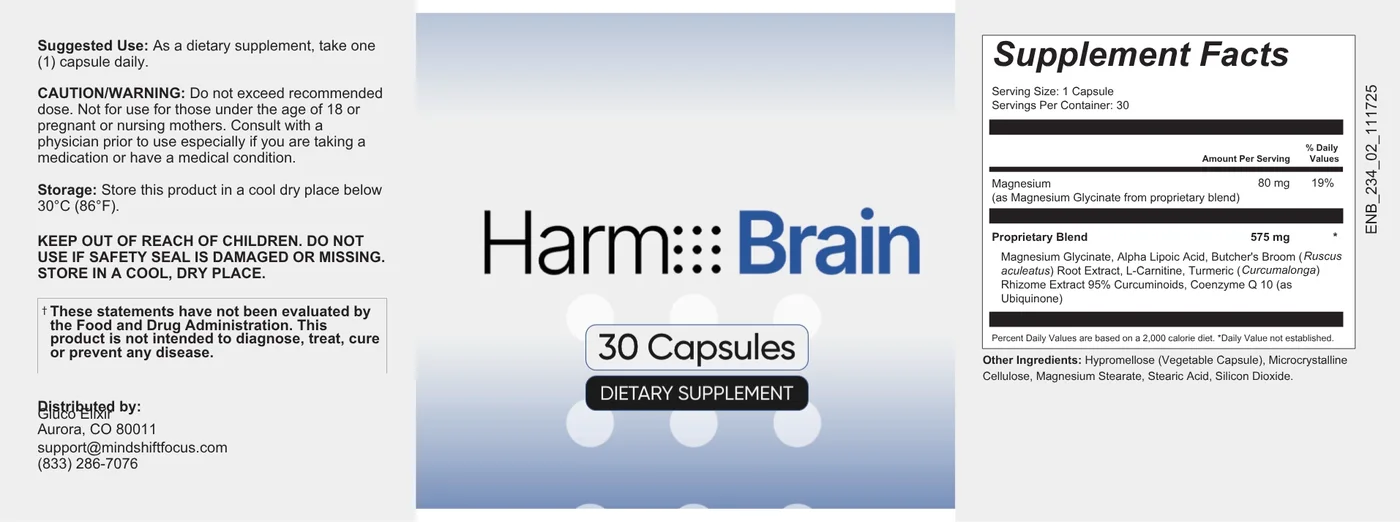
- The label. Consult a physician first if you take a medication.
The label’s own line
Do not exceed recommended dose. Not for use for those under the age of 18 or pregnant or nursing mothers. Consult with a physician prior to use especially if you are taking a medication or have a medical condition.
The Harmo Brain label
That caution covers every medication in general. This article is the specific version: which of the six blend materials has a published point of contact with which kind of prescription, and where the evidence for each comes from.
A proprietary blend does not print the amounts of these materials, but it does name them, and a name is all an interaction check needs. That is the most useful thing a blend label does for anyone on a prescription.
CoQ10, warfarin and insulin
NCCIH’s page on coenzyme Q10 reports no serious side effects in the research, and notes that CoQ10 may interact with warfarin, the blood thinner, and with insulin. Warfarin is dosed against regular blood tests, so a new supplement that might shift its effect is exactly the kind of change the prescriber needs to hear about.
CoQ10 comes up for another prescription too. People taking statins sometimes try it for muscle aches, and NCCIH’s overall reading is that the evidence does not support relief of statin muscle pain. If a statin is on your list, it belongs in the same conversation.
In Harmo Brain, CoQ10 is the last and smallest of the six blend materials.
Alpha lipoic acid and blood sugar
Alpha lipoic acid has been linked, in case reports, to insulin autoimmune syndrome: the body makes antibodies to its own insulin, and blood sugar can fall too low. It is rare. One published case describes a 35-year-old woman with low blood sugar two weeks after starting alpha lipoic acid, whose antibodies had cleared by the fifteenth month.
For most people it is a curiosity. For anyone on insulin or another medicine that lowers blood sugar, it is a reason to mention alpha lipoic acid before starting and to report any unexplained low readings. In Harmo Brain, alpha lipoic acid is second in the blend.
L-carnitine and thyroid hormone
A randomised trial gave 2 or 4 g of L-carnitine a day for six months to 50 women taking thyroid hormone, and found that carnitine blunted thyroid hormone action. The study was designed around that effect, in people whose thyroid hormone was deliberately high.
The amounts are worth setting side by side. The whole blend in a capsule weighs 575 mg, and L-carnitine is fourth of six in it, so the carnitine in one capsule is a fraction of the 2,000 to 4,000 mg the trial used. That makes a large effect unlikely. It does not make the point irrelevant to someone whose thyroid dose is being adjusted, and it takes one sentence to mention.
Check the list, then decide
Six named materials, one capsule a day, and 60 days from purchase to change your mind. Order Harmo Brain through the official checkout.
Price at checkout · 60 days from purchase
Six points, one table
| Ingredient | Medicine or condition | What the research says |
|---|---|---|
| Alpha lipoic acid | diabetes medicines and insulin | Alpha lipoic acid has been linked to insulin autoimmune syndrome, a rare cause of low blood sugar, in case reports. (source) |
| Coenzyme Q10 | warfarin and insulin | NCCIH notes CoQ10 may interact with the blood thinner warfarin and with insulin. (source) |
| L-carnitine | thyroid hormone (levothyroxine) | L-carnitine acts as a peripheral antagonist of thyroid hormone at trial doses of 2 to 4 g a day. (source) |
| Magnesium | bisphosphonates and some antibiotics | The NIH Office of Dietary Supplements lists oral bisphosphonates, tetracyclines and quinolone antibiotics as medicines magnesium may interact with, and notes that diuretics and proton pump inhibitors can change magnesium status. (source) |
| Butcher’s broom | high blood pressure | Ruscus acts on alpha-adrenergic receptors and tightens veins, which is why it has been proposed as a remedy for low blood pressure. (source) |
| Turmeric extract | liver conditions and pregnancy | Turmeric products have been linked to liver injury, and NCCIH says turmeric supplements may be unsafe in pregnancy. (source) |
The table is the same one printed on the side effects page and the FAQ, so the three pages can never disagree. The six points do not carry equal weight, and it helps to know what kind of evidence sits behind each:
| Point | Kind of evidence | How to read it |
|---|---|---|
| CoQ10 with warfarin and insulin | A federal health agency’s summary | A caution to act on: tell the prescriber. |
| Alpha lipoic acid and low blood sugar | Case reports | Rare, but real enough to mention on diabetes medicine. |
| L-carnitine and thyroid hormone | A randomised trial at 2 to 4 g a day | Clear at trial amounts; far above a capsule’s share. |
| Magnesium and blood pressure | A meta-analysis of 34 trials | A small effect in the direction of the medicine. |
| Butcher’s broom and blood pressure | A review with one case | A described mechanism rather than a measured interaction. |
| Turmeric and the liver | A case series from a national network | Uncommon, serious when it happens; know the signs. |
Magnesium, butcher’s broom and blood pressure
Two materials act on blood pressure, in opposite directions. Magnesium lowered it slightly in pooled trials, by about 2 mm Hg, which is the direction a blood-pressure medicine pushes. Butcher’s broom acts on alpha-adrenergic receptors and tightens veins, which is why it has been proposed for low blood pressure.
Neither effect is likely to be large at the amounts a single capsule can hold. Both are worth naming if you take blood-pressure medicine or have been told your pressure is high, because a prescriber reading a home blood-pressure log will want to know what changed.
Turmeric and the liver
A US drug-induced liver injury network has described ten liver-injury cases linked to turmeric products since 2011, most appearing one to four months after starting, one of them fatal. NCCIH notes that highly bioavailable curcumin formulations may harm the liver and that turmeric supplements may be unsafe in pregnancy.
The label already rules out pregnancy. For everyone else the practical point is short: stop and seek advice promptly if you notice dark urine, pale stools or yellowing of the skin or eyes while taking any turmeric product.
Other supplements count too
Interactions are not only between a supplement and a prescription. CoQ10, alpha lipoic acid, L-carnitine, magnesium and turmeric are all sold on their own and in other formulas, so the same material can arrive from two bottles at once.
Magnesium is the easiest to add up, because it is the one with a printed figure and an upper limit: 350 mg a day from supplements for adults, against the 80 mg here. For the others, the check is simpler still. If a material in this blend also appears on another label you take, that is worth a line on the list you give your prescriber.
Timing is a question worth asking
Some prescriptions come with instructions about spacing: thyroid hormone, for instance, is usually taken on its own, away from food and other supplements. A once-daily capsule is easy to move to another part of the day, and it is worth asking whether it should be.
The Harmo Brain label sets the amount, one capsule, and leaves the time to you. That flexibility is useful here: whatever time your prescriber suggests, the calendar and the refund window work the same way.
When to stop and call
- A change in your INR readings after starting, if you take warfarin.
- Shakiness, sweating, confusion or other signs of low blood sugar, if you take a medicine that lowers it.
- Dark urine, pale stools or yellowing of the skin or eyes, with any turmeric product.
- Anything new and unexplained in the first weeks, written down with the date.
Stop the capsule and call whoever prescribes your medicine. If you then decide the capsule is not for you, order support on +1 (302) 200-3480 opens a refund inside the 60-day window, counted from the date of purchase.
What the label already rules out
Before any interaction question, the label settles three groups outright. It is not for anyone under 18. It is not for pregnant or nursing mothers, which also covers the NCCIH caution on turmeric in pregnancy. And it asks anyone taking a medication or living with a medical condition to consult a physician before use, which is the conversation this article is written to make quicker.
Taking the list to your prescriber
- 1
Bring the names
The six blend materials, in panel order, and the 80 mg of magnesium.
- 2
Bring the dose
One capsule a day, as the label directs.
- 3
Bring the rest
Every other supplement and medicine you take, with doses.
- 4
Ask one question
Is there anything here I should not combine, or anything you want to monitor?
A note on what this is
Harmo Brain is a dietary supplement, not a medicine. Nothing in this article describes it as a treatment for dementia, memory loss or any other condition. Memory or thinking that is changing in a way that worries you is a reason to see a clinician, not a reason to start a capsule.
